Streamlined Architecture
Simplifies installation, lowers raw material overhead and substantially reduces long-term maintenance cost.

What is a bus bar?
A bus bar is a highly conductive engineered component designed to collect electrical energy from an incoming source and efficiently redistribute it across multiple outgoing circuits or devices.
Serving as the backbone for electrical grounding and heavy-duty power distribution, bus bars can be tailored into flat strips, solid bars, flexible laminates and custom geometries to match continuous current requirements and enclosure constraints.
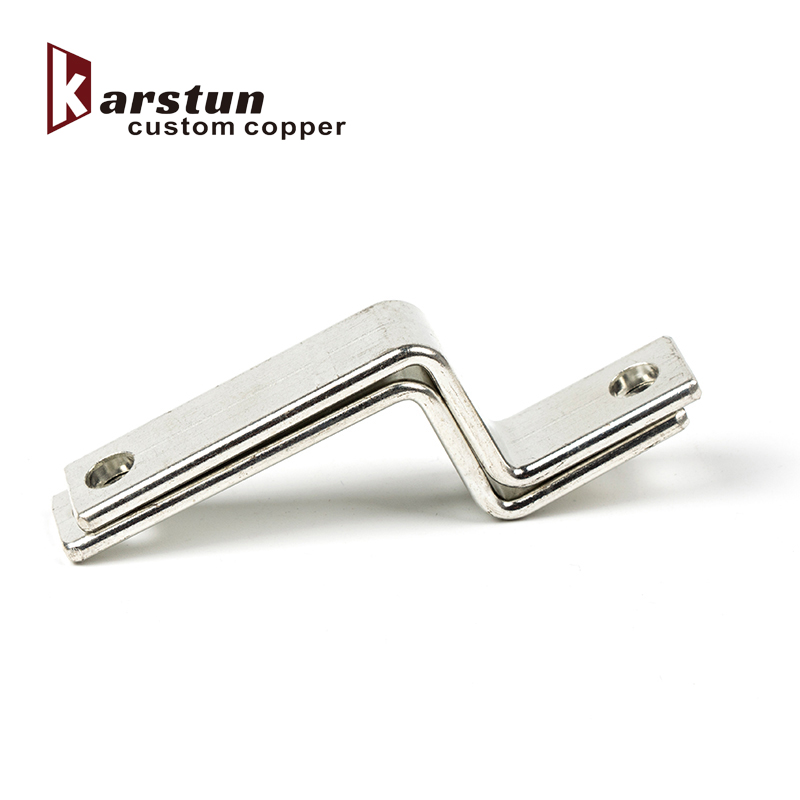
Featured Solutions
Karstun manufactures bus bars to drawing, including forming, punching, welding, plating and insulation support.
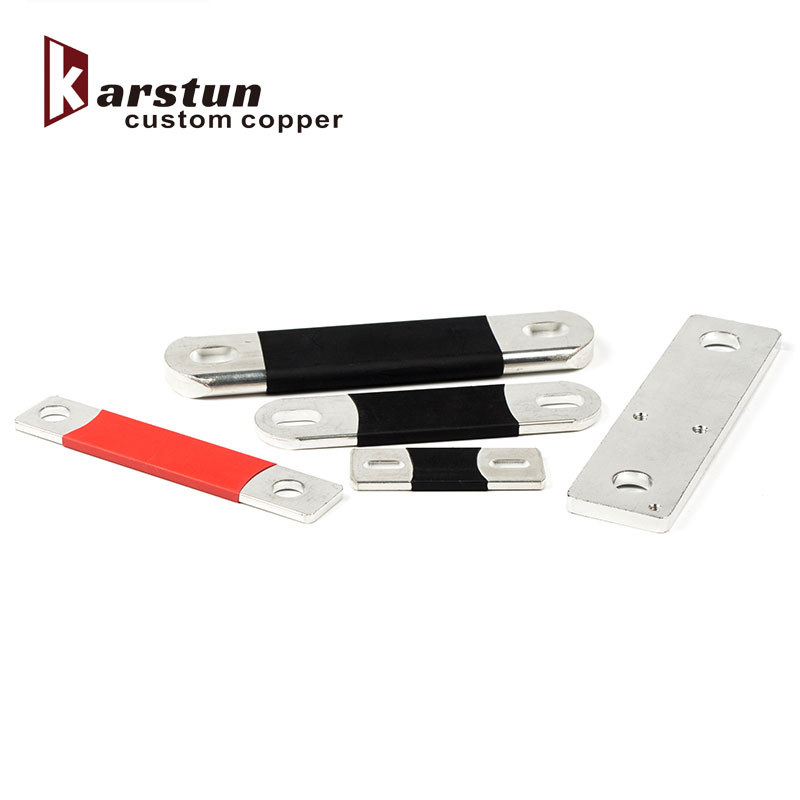
Engineered from multiple thin, high-conductivity laminates, flexible bus bars absorb mechanical vibration, counteract thermal expansion and compensate for enclosure alignment tolerances.

Epoxy coating is a strong insulation method for complex, 3D-bent or intricately contoured conductors operating in tight spaces or under assembly stress.
Materials
Select copper, copper alloy or aluminum according to conductivity, machining requirement, weight target and operating environment.
The commercial benchmark for heavy power applications, featuring minimum 100% IACS conductivity in annealed state. Pure 99.9% copper, reliable for high-current bus bars. Because it is ductile, controlled-speed machining helps prevent tool wear and keeps edge finishes clean.
Refined to ultra-low oxygen levels for high ductility, solderability and resistance to hydrogen embrittlement during butt welding. A premium choice for vacuum, high-precision electronics and demanding conductive environments.
Engineered for intricate CNC turning and milling. Tellurium improves chip-breaking performance while maintaining more than 90 to 93% of pure copper conductivity, making it useful for detailed machined conductive parts.
Primarily used for specialized pipe and tubular bus structures. The phosphorus addition improves welding and brazing capability, though conductivity is lower, making it suitable for targeted thermal and structural electrical paths.
A robust copper-zinc alloy with a dark-gold finish. Zinc improves rigidity and C360 has the highest machinability rating among copper-based alloys, suitable for brackets, soldered terminals and secondary mechanical parts.
Alloys such as 1100 and 1350 provide maximum thermal dissipation and high electrical conductivity, typically 50% to 61% IACS. 1100 offers the highest mechanical strength within this commercially pure series.
Structural alloys such as 6061 provide yield strength and weldability. For electrical busbar layouts, 6101 balances structural integrity with 57% to 61% IACS conductivity.
Technical Background
Material temper affects hardness, forming ability, machining stability and long-term reliability. Karstun can help match the temper to the product structure and process route.
Pure aluminum delivers approximately 61% of copper conductivity while weighing less than one-third of copper by volume. This creates strong ampacity-per-pound performance for weight-critical systems, and aluminum alloys can be selected by temper for mechanical, structural and electrical targets.
Temper describes copper grain-level hardness and tensile profile, controlled through annealing or cold finishing. Unlike steel or standard aluminum alloys, copper cannot be reinforced by final-stage heat treatment, so protective-atmosphere annealing helps avoid scale, staining and oxygen or hydrogen penetration.
Cold finishing creates permanent deformation below the recrystallization threshold. Precision rolling, drawing, multi-axis bending and cold hammering create strain hardening. Karstun can align CDA-style temper choices from H01 fully soft to H04 fully hard with the end use.
Fully annealed copper has recrystallized, stress-free grains. This highly ductile state supports tight-radius bending, cold heading, swaging and mirror-polishing preparation.
Made by cold drawing or cold rolling soft metal to final dimensions, producing controlled grain elongation. This is a common industrial standard for rectangular and square bus bars, balancing CNC machining, sweeping-radius bends and moderate forming.
Produced through intensive cold reduction for compressed grain orientation. It supports precision blanking, high-speed shearing and clean CNC milling, but is generally not recommended for radius bending or swaging.
Stress-relieved, recrystallized copper sheet and strip are suitable for detailed sheet-metal forming, deep drawing and precision spinning. The surface is compatible with industrial electroplating and architectural finishing.
Calibrated cold rolling creates slight to moderate strain hardening. 1/4 hard supports shallow stamping and forming, while 1/2 hard gives consistent springback-controlled 90-degree bends without structural micro-cracking.
Highly cold-worked strip provides enhanced shear resistance and flatness. It is suitable for heavy blanking, mechanical shearing and profile machining while retaining the ability to execute robust 90-degree corner forming.
Custom Production
Include material, thickness, size, hole pattern, surface treatment, insulation requirement, quantity and application environment.